
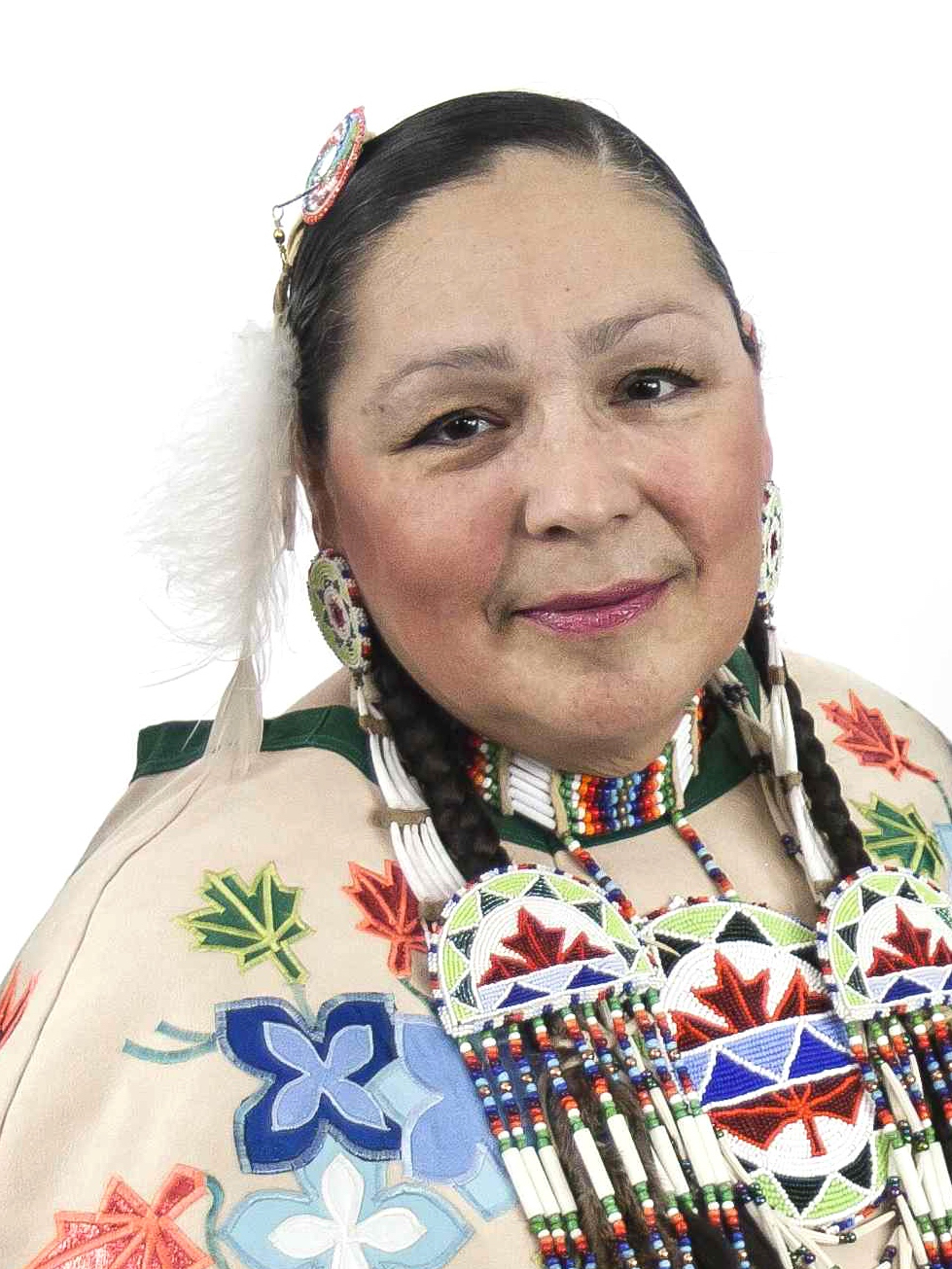
Dorene Day Waubanewquay will be joining Larry Long & American Roots Revue on Saturday, May 9th at the Dakota.
Dorene Day Waubanewquay is Ojibwe-Anishinabe Kwe of the Waubizayshi O’dodem – Marten Clan, from Asabikone zaaga I’ gunning – Bois Forte Reservation in northern Minnesota. There, she carries the responsibility of song keeper for her Midewiwin lodge. Moreover, her name means “Daybreak Woman,” someone who asks the darkness to give way to the light each morning.
Dorene will be joining Larry Long, Robert Robinson, Tonia Hughes Kendrick and JD Steele for two shows at the Dakota on Saturday, May 9th.
Waubanewquay’s healing song at No Kings rally in St. Paul, Minnesota on March 28th was a pin drop moment for all who attended. In response the StarTribune honored her with the following article by Chris Riemenschneider.
Meet the St. Paul Ojibwe singer who opened for Springsteen
Dorene Day Waubanewquay’s performance at the No Kings rally wasn’t the first time her family played a big role in Minnesota history.
Her American Indian name, Waubanewquay, means “Daybreak Woman,” someone who asks the darkness to give way to the light each morning. That’s more or less the role she was asked to play by organizers of the No Kings rally at the Minnesota State Capitol on March 28.
Talking two days after singing to an estimated 100,000 people at the rally, Dorene Day Waubanewquay laughed about another key role she wound up filling at the nationally watched protest event.
“One of my girlfriends called me afterward and said, ‘You can now say you opened for Bruce Springsteen!’” Day recounted.
An Ojibwe singer from St. Paul who also works as a midwife and educator — and mother and grandmother, too — Day made a big impression delivering her “song of healing” just a few minutes before Springsteen performed at Minnesota’s flagship installment of the nationwide No Kings rallies.
Day’s performance was singled out by many as one of the most moving and memorable parts of the St. Paul rally. One observer described it in a Facebook post as a “pin-drop moment.” The event’s host, comedian Lizz Winstead, called it “an incredible honor to have Dorene share such incredible words of healing.”
“When the heart creates the message, the meaning comes through regardless of the language,” Winstead said afterward.
Day herself was rather blown away, too, but for a different reason. “I’d never really heard the sound of my voice echoing back like that before,” the 66-year-old singer said, referring to the bounce of her vocals off neighboring buildings over the large sound system.
“I’m used to singing over drums and chanting men at powwows without a microphone, so I always have to sing loud,” she said. “And I think because of that I sang loud enough to really reach everyone at this event.”
The song she delivered is an original one she wrote that does not have a title. She came up with it years ago on a long drive along U.S. Route 2 between Red Cliff Indian Reservation in northern Wisconsin and White Earth Reservation in northwestern Minnesota, both places where she regularly does educational and healing work.
An Anishinaabe Ojibwe whose own nation is the Bois Forte Band of Chippewa from northern Minnesota, Day said the lyrics of her No Kings song refer to “Grandmother Moon,” who is important in their religious world for healing purposes.
“It acknowledges Grandmother Moon as she travels the night sky, and says, ‘She’s healing you / She’s healing me too,’” she explained.
Reflecting on how the song’s purpose fit in with the broader message of the rally — where ICE’s Operation Metro Surge in Minnesota was at the heart of the protests — Day said: “Our people know how to carry on through trauma like this.
“I believe that Indigenous people’s ways, our spiritual beliefs and way of life, can aid society when we have these grave and huge issues that we face,” she said.
“I know in my life, and in the lives of my children and grandchildren, it has helped us build for the future. And so I was happy to try to provide that for everyone else at the event.”
This was not the first time the Day family name has been tied to pivotal events in Minnesota history.
Her father, Clyde George Day, was involved in mapping out and building portages in what would become the Boundary Waters Canoe Area Wilderness. After Clyde was murdered in an unsolved case 50 years ago in Virginia, Minn., Dorene said, her mother, Charlotte, moved the family to St. Paul, where she became highly active in the American Indian Movement (AIM) and co-founded the Red School House in 1972, a school for Native children to combat discrimination against them in other schools.
Dorene learned much of the Ojibwe language and traditions from the Red School House, and she has carried it forward to teach all around Minnesota and Wisconsin. Concurrently, she also has taken her experiences as a midwife and doula to advocate for better and “more traditional” birth practices for all Native woman.
“I really feel birth is a sovereignty issue for us,” she said, reiterating that American Indian women “were having sterilization forced upon us as recently as the 1970s.”
All that, and Day still finds time to sing. She left the No Kings rally to perform at the Fond du Lac Band’s powwow in Cloquet on March 29. She did not even get to wait around to hear Springsteen perform, or Joan Baez or Maggie Rogers (who performed later).
While proud to be associated with those names, Day said she’s even prouder to be carrying on the tradition of another, lesser-known singer: her late father.
“His singing was very powerful and was all I heard growing up,” she said.
“I’m always sad my children and grandchildren — who are also now all singers — didn’t ever get to hear my father sing. So when I do something like this, it’s like they’re still hearing him sing.”
Link to fStarTribune Article by Chris: https://www.startribune.com/ojibwe-healing-singer-dorene-day-waubanewquay-no-kings-rally-st-paul-springsteen-capitol/601650909